The comet was already dead when I pressed the button
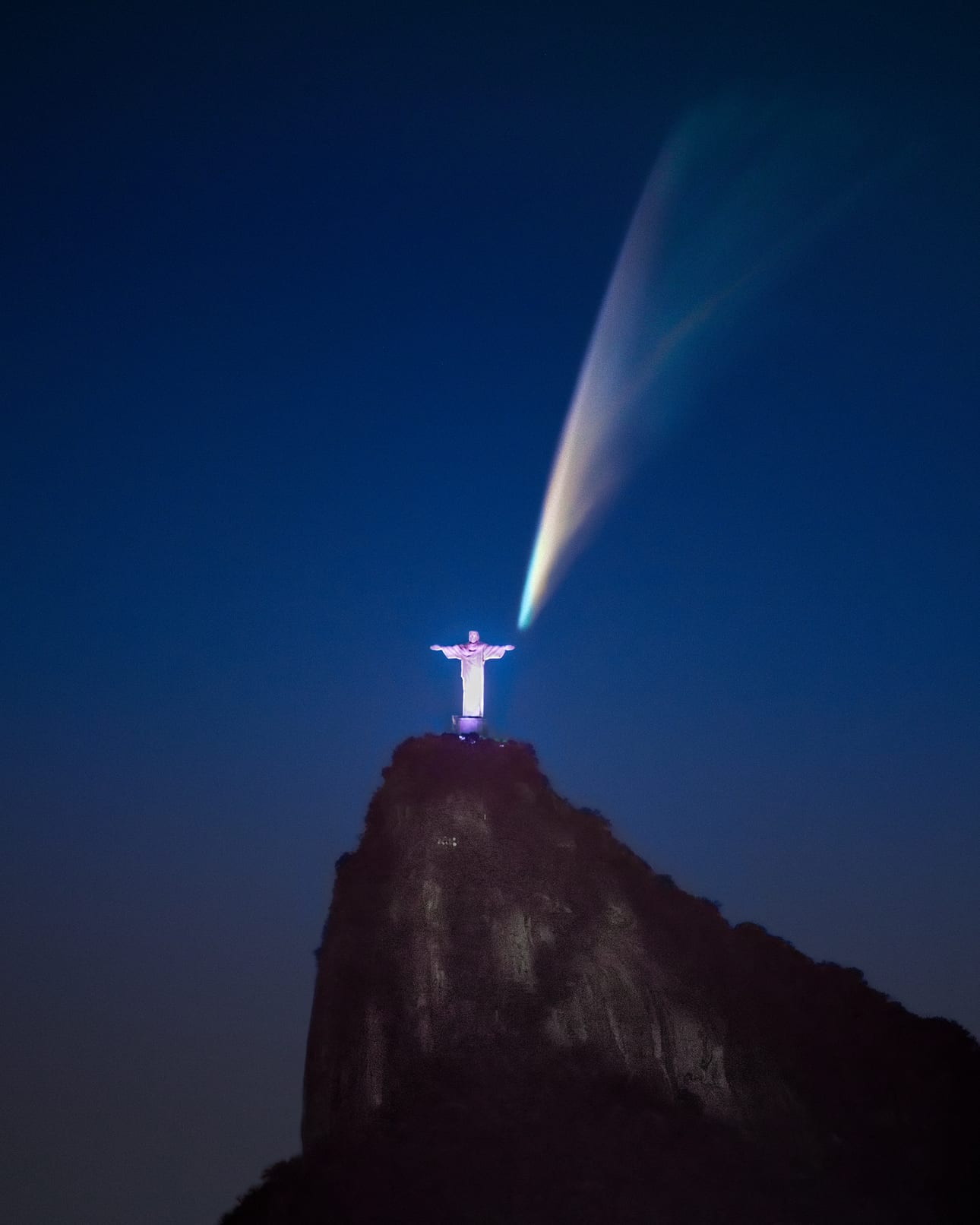
The comet in this photo was already dead when I pressed the button.
On the night of January 20, 2025, I photographed comet C/2024 G3 (ATLAS) aligned with the hand of Christ the Redeemer, from Icaraí beach in Niterói. Days later, astronomers would confirm that the nucleus had already disintegrated before that night.
I did not know. Nobody there knew. What crossed the sky of Rio that night was the still dense tail of a headless comet, disintegrated under the stress of its close pass by the Sun. Its last breath, traveling as light.
I will come back to that part. Let me start with the traffic.
They laughed at me. "Bruno, you are driving to NITERÓI to take a picture?" "A comet in Rio? What comet?" "And the holiday traffic on the bridge?" The sky had been overcast for days and I was waiting for a window to attempt the image I had in my head: the comet resting on the hand of Christ the Redeemer.
And look, the skeptics had the numbers on their side. For this photo to exist, EVERYTHING had to work at the same time: the sky opening in the exact direction, at the exact hour, the air cooperating, the alignment closing, the equipment responding. The odds of every factor conspiring in my favor were close to none. On the day, with a black sky as we left Rio, my amateur meteorologist nowcasting updated the optimistic side of the equation: maybe a 20% chance just of the sky opening. The rest was still faith.
But there is a math I learned in practice: the most important photos of my life came from days when I almost gave up. So we went.
Crossing the bridge, it was raining in São Gonçalo. And raining in Niterói. But the sun bothering me in the rearview mirror told another story: to the west, exactly where the comet would set, there were bands of clear sky. The whole landscape was that golden ambiguity, clouds and openings fighting over the twilight.
Driving through Icaraí, I said out loud, more to myself than to anyone: "there is hope". There was still time for the clouds to the west to move. And from the back seat came the reply: Zuc, my little Maltese, made that funny sound of hers, half grunt, half commentary, the canine version of "that is right". Excited, agreeing. Animal sixth sense: she knew before I did that the night would work out.
Why Icaraí
The whole photo is a triangulation. The comet would set to the west, so I needed to be east of Christ, far enough for perspective to perform the magic photographers call compression: the farther away you are, with a long lens, the more the relative sizes flatten and the comet appears HUGE next to the statue. Azimuth, distance and the height of Christ on the horizon, everything had to close at the same time.
Icaraí was the point where that equation closed. I planned it in PlanIt Pro, an app that even has Christ modeled in 3D so you can visualize the scene before leaving home. The margin of error for the spot where I planted the tripod was about two meters, give or take. Annoyingly precise, on purpose.
We arrived early, checked the exact spot and fulfilled a VERY important ritual of landscape photography in the 40 degree Rio summer: a well deserved draft beer, waiting for the hour.
Christ shimmering
Minutes before the critical hour, I set up the equipment and ran a test with the settings I had planned the day before.
Christ appeared blurred on the screen. Rippling. Dancing.
You know this effect: it is the same illusion as heat on a road, that trembling air rising from the asphalt. The difference is that, with the naked eye, I could see nothing there. But a 600mm lens is a brutal amplifier, and it amplifies everything: the comet I wanted and the atmospheric distortion I did not want. The absurd heat of that day had turned the air between me and Christ into a trembling lens.
And my original plan died in that test.
In photography, there are always at least three basic parameters you need to control: how long the shutter stays open, how wide the lens opens and the volume of the sensor. Think of three juggling balls with a magnet between them: you cannot move one without the others shifting. Every adjustment pulls the other two.
The previous day's plan bet everything on the first ball: shutter open longer, gathering more light from the comet with the sensor at minimum volume, meaning less noise and more quality. But a slow shutter with dancing air is a recipe for a blurred statue. So the dribble came in a chain: I sped up the shutter to freeze the dance, and the magnet pulled the other two balls. I opened the lens all the way, sacrificing part of the overall sharpness I wanted. And there was still not enough light. One ball remained: pushing the sensor hard, raising the ISO to a volume 16 times higher than planned, and praying I could clean up the noise later, on the computer.
It was the ninja decision of the night. Made in seconds, with the comet already visible to the naked eye, descending toward the hand of Christ.
When the two aligned and I saw the image in the viewfinder, I got chills in the middle of unbearable heat. The body gave that release that only comes after so much held expectation.
The twenty hours nobody sees
Now, the part I insist on telling, because transparency is a house value here.
This photo required a LOT of computer. It took more than twenty hours of post-processing: exposure stacking, treating the comet and the foreground separately, and fine local adjustments, brushstroke by brushstroke, to rescue from the noise the information the sensor captured in that split-second decision.
I will be radically honest: what you see in this image was impossible to see with the naked eye. Live, the comet was far more subtle. And this photo sits at the very limit of what I consider acceptable in treatment. But the line I do not cross is a single one: everything in it is real light, captured in that place, on that night, by that sensor. It is not a composite. It is a beautiful enhancement of what the sky actually delivered and the human eye cannot reach.
The news: the nucleus of ATLAS had already disintegrated
Days after the photo, taken on January 20, 2025, came the confirmation from astronomers: the nucleus of ATLAS had not survived its approach to the Sun. It had disintegrated BEFORE that night. What we chased by car, waited for with a beer in hand and froze at 1/4 of a second was a comet without a nucleus, its dense tail still glowing by inertia, falling apart as it crossed our sky.
I photographed the last portrait of a comet that had already died. This image cannot be repeated by anyone, ever again. Not because I was better than anyone, but because the model is gone.
That night, knowing none of this, we closed the hunt with a bife ancho by São Francisco beach. I was not alone in this madness: it was a small crew of encouragers, each one pushing the expedition in their own way. That night we were all on the same team, looking at the same sky.
And there is the lesson I take from every hunt: you can laugh at me on the way there. Only those crazy enough to believe they can achieve the improbable are the ones who do.
When was the last time you went after something with odds close to none?